

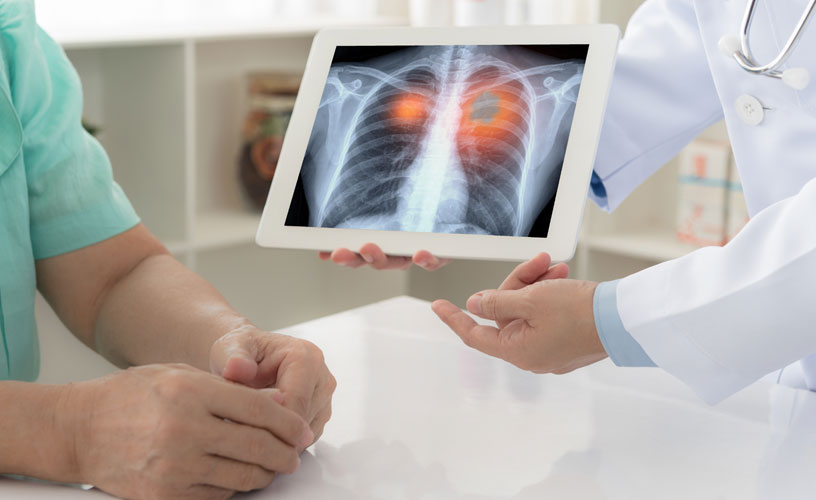
Lung cancer typically doesn't cause signs and symptoms in its earliest stages. Signs and symptoms of lung cancer typically occur when the disease is advanced.
Signs and symptoms of lung cancer may include:
- A new cough that doesn't go away
- Coughing up blood, even a small amount
- Shortness of breath
- Chest pain
- Hoarseness
- Losing weight without trying
- Bone pain
- Headache
Smoking causes the majority of lung cancers — both in smokers and in people exposed to secondhand smoke. But lung cancer also occurs in people who never smoked and in those who never had prolonged exposure to secondhand smoke. In these cases, there may be no clear cause of lung cancer.
A number of factors may increase your risk of lung cancer. Some risk factors can be controlled, for instance, by quitting smoking. And other factors can't be controlled, such as your family history.
Risk factors for lung cancer include:
- Smoking - Your risk of lung cancer increases with the number of cigarettes you smoke each day and the number of years you have smoked. Quitting at any age can significantly lower your risk of developing lung cancer.
- Exposure to secondhand smoke - Even if you don't smoke, your risk of lung cancer increases if you're exposed to secondhand smoke.
- Previous radiation therapy - If you've undergone radiation therapy to the chest for another type of cancer, you may have an increased risk of developing lung cancer.
- Exposure to radon gas - Radon is produced by the natural breakdown of uranium in soil, rock and water that eventually becomes part of the air you breathe. Unsafe levels of radon can accumulate in any building, including homes.
- Exposure to asbestos and other carcinogens -Workplace exposure to asbestos and other substances known to cause cancer such as arsenic, chromium and nickel can increase your risk of developing lung cancer, especially if you're a smoker.
- Family history of lung cancer - People with a parent, sibling or child with lung cancer have an increased risk of the disease.
Lung cancer can cause complications, such as:
- Shortness of breath - People with lung cancer can experience shortness of breath if cancer grows to block the major airways. Lung cancer can also cause fluid to accumulate around the lungs, making it harder for the affected lung to expand fully when you inhale.
- Coughing up blood - Lung cancer can cause bleeding in the airway, which can cause you to cough up blood (hemoptysis).
- Pain - Advanced lung cancer that spreads to the lining of a lung or to another area of the body, such as a bone, can cause pain.
- Fluid in the chest (pleural effusion) - Lung cancer can cause fluid to accumulate in the space that surrounds the affected lung in the chest cavity (pleural space).
- Cancer that spreads to other parts of the body (metastasis). Lung cancer often spreads (metastasizes) to other parts of the body, such as the brain and the bones.
- Cancer that spreads can cause pain, nausea, headaches, or other signs and symptoms depending on what organ is affected.
There's no sure way to prevent lung cancer, but you can reduce your risk if you:
- Don't smoke - If you've never smoked, don't start. Talk to your children about not smoking so that they can understand how to avoid this major risk factor for lung cancer.
- Stop smoking. Stop smoking now. Quitting reduces your risk of lung cancer, even if you've smoked for years.
- Avoid secondhand smoke - If you live or work with a smoker, urge him or her to quit. At the very least, ask him or her to smoke outside. Avoid areas where people smoke, such as bars and restaurants, and seek out smoke-free options.
- Avoid carcinogens at work - Take precautions to protect yourself from exposure to toxic chemicals at work. Follow your employer's precautions. For instance, if you're given a face mask for protection, always wear it.
- Eat a diet full of fruits and vegetables - Choose a healthy diet with a variety of fruits and vegetables. Food sources of vitamins and nutrients are best. Avoid taking large doses of vitamins in pill form, as they may be harmful.
- Exercise most days of the week - If you don't exercise regularly, start out slowly. Try to exercise most days of the week.